
Why Sand Blasting Is a Critical Prep Step Before Any Metal Finish
A metal finish only performs as well as the surface underneath it. You can specify the toughest powder coat, a high-grade industrial paint, or a premium primer, and none of it will hold if the steel below still carries rust, mill scale, oil, or a failing old coating. This is the quiet truth behind every durable railing, gate, and fence on the Front Range, and it is why Sand Blasting Services in Denver are treated as a foundation step rather than an optional add-on. Before any color goes on, the metal has to be clean and correctly textured, and sand blasting is the most reliable way to get it there.
Denver conditions raise the stakes. Intense high-altitude UV, wide daily temperature swings, wind-driven grit, and repeated freeze-thaw cycles all test the bond between a finish and the metal it protects. When that bond is weak because the surface was never prepared properly, the finish starts to fail from the edges and from underneath, often long before the coating itself would have worn out. Getting the prep right is the difference between metalwork that stays sharp for years and metalwork that needs stripping and refinishing far too soon.
This guide explains what sand blasting actually does to prepare metal, why skipping or shortcutting prep leads to early finish failure, and how blasting supports every type of finish rather than just one. Powder coating is part of the picture, but only as one option among several, because the same clean, profiled surface is what paint, primer, and protective sealers all depend on as well.
What Sand Blasting Does to Prepare Metal for Finishing
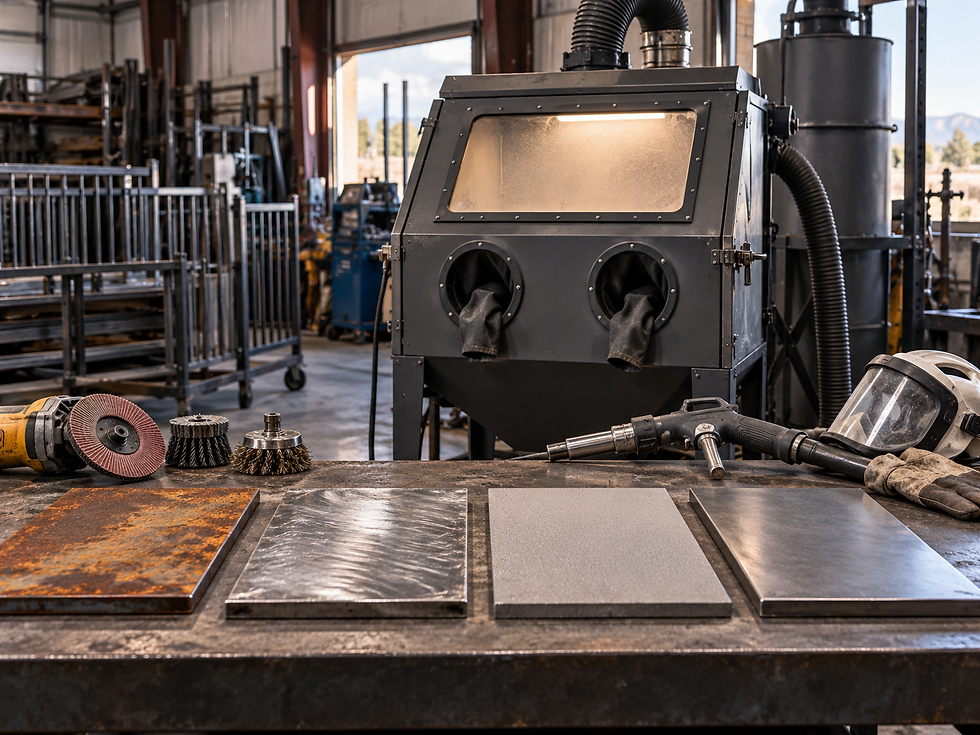
Sand blasting, more accurately described today as dry abrasive blasting, uses compressed air to propel abrasive media against a metal surface at high velocity. Each particle strikes the steel and the cumulative impact does two jobs at once. It strips away everything that does not belong on the surface, and it reshapes the bare metal into a texture a coating can grip. Most modern shops no longer use actual silica sand because of dust and health concerns, and instead run engineered abrasives such as steel grit, aluminum oxide, or crushed glass. The name sand blasting has simply stuck as the everyday term for the process.
The value of blasting comes from doing both of those jobs in a single, controlled pass. Wiping metal with solvent might remove oil but leaves rust and scale behind. Grinding might knock off heavy rust but leaves an inconsistent surface and can polish the steel smooth in places. Blasting cleans and profiles at the same time, and it reaches into pits, corners, weld seams, and ornamental detail that hand tools struggle to touch. That combination is what makes it the standard prep for metal that has to survive outdoors in Colorado.
Removing Rust, Scale, and Old Coatings
New steel usually arrives with a thin blue-gray layer called mill scale, formed during hot rolling at the mill. It can look sound, but it is not firmly bonded, and any finish applied over it is only as strong as the loose scale beneath. Over time that scale flakes and takes the finish with it. Older metalwork brings its own problems, including surface rust, deeper pitting corrosion, chalked or peeling paint, and layers of previous coatings that no longer adhere. There may also be invisible contaminants such as oil, grease, wax, and salt residue picked up from Denver roads in winter.
Blasting removes all of it back to a sound, uniform substrate. Rust and scale are knocked free, failing coatings are stripped rather than painted over, and the surface is left consistent from one end of the piece to the other. That uniformity matters because a coating cannot compensate for a patchy base. If half a railing is clean bare steel and the other half still holds old paint, the new finish will age and fail unevenly, and the weak areas drag down the whole piece.
Creating the Anchor Profile Coatings Grip
Cleaning is only half of what blasting accomplishes. The second half is the anchor profile, the fine peak-and-valley texture the abrasive leaves behind. Bare steel that looks smooth to the eye is far too slick at a microscopic level for a coating to hold securely. The anchor profile increases the real surface area and gives paint, primer, and powder coat physical texture to lock into as they cure. Think of it as the difference between paint spread on glass and paint worked into a lightly sanded board.
Profile depth is measurable and is matched to the finish being applied. Too shallow and the coating has little to grab, so adhesion suffers. Too aggressive and the peaks can stand taller than a thin coating film, leaving high points that corrode early. A properly tuned blast produces a consistent profile across the entire part, which is exactly what a long-lasting finish needs. This is the step that separates blasting from simple cleaning, and it is why blasted steel bonds so much better than steel prepped any other way.
This is also why a coating specification and a blasting standard go hand in hand in professional work. Industry surface-cleanliness and profile standards exist precisely because finish manufacturers know their products will only perform over a surface prepared to a defined level. When a shop treats blasting as a measurable step rather than a rushed cleanup, the finish that follows behaves the way it was engineered to, and the metal gets the full corrosion protection the coating promises. Skipping or guessing at that standard is where avoidable failures begin, long before the coating itself has any reason to wear out.
Why Skipping Prep Leads to Finish Failure
When metal is coated without proper preparation, the finish is being asked to bond to contamination instead of steel. It might look correct for a season, because a fresh coat of powder or paint hides a great deal. The trouble shows up later, usually once Denver weather has cycled through a few hot days and cold nights, and by then the only real fix is to strip the piece and start over. Understanding the common failure modes makes the reason for prep obvious.
• Adhesion loss, where the finish never truly bonds and lifts away in sheets or flakes once it is stressed by temperature swings or moisture.
• Peeling and chipping along edges and high-wear areas, which then let water reach the bare steel underneath.
• Blistering, where trapped oil, moisture, or solvent under the film expands and pushes the coating up into bubbles.
• Under-film corrosion, where rust that was coated over keeps spreading beneath the finish and lifts it from below.
Under-film corrosion is the most damaging of these because it is hidden. Rust that was painted over does not stop. It continues to grow under the coating, expanding as it does, until the finish is pushed off from underneath and the surface is worse than before. A finish applied over active rust is not protection, it is a lid on a problem that keeps working. Blasting removes that rust first so the coating bonds to clean metal and the corrosion has nowhere to hide.
There is also a cost angle to skipping prep, even without talking dollar figures. A finish that fails early has to be removed and reapplied, which means paying to prepare and coat the same piece a second time, plus the disruption of taking railings, gates, or fencing out of service. Thorough blasting on the front end is the cheaper path over the life of the metal, because it lets the finish deliver the full service it was designed for instead of failing halfway through.
It also helps to think about what a coating is actually being asked to do outdoors in Colorado. A finish on a gate or railing is the barrier that keeps moisture, UV, and road salt away from the steel for years. If that barrier is compromised at the bond line from the start, it cannot hold that line, and the metal it was meant to protect begins corroding on schedule. Good prep is not about making the coating look better on day one, it is about making sure the barrier stays intact through hundreds of freeze-thaw cycles and seasons of high-altitude sun.
How Sand Blasting Supports Every Type of Metal Finish
One of the biggest misconceptions is that blasting is a powder-coating step. It is not tied to any single finish. Clean, profiled steel is the shared starting point for essentially every coating a metal shop applies, and the finish you choose sits on top of that foundation rather than replacing the need for it. Blasting is the common denominator, and the finish is a decision made after the surface is right.
Powder coating is one popular option, valued for its durable, uniform film and wide color range, and it bonds especially well to a correctly profiled surface because the electrostatically applied powder needs clean metal to adhere and cure evenly. Wet or liquid industrial paint is another route, often chosen for touch-up ability, specialized colors, or pieces that cannot go through a cure oven, and it relies on the same clean profile to resist peeling. Primer systems, whether under paint or as a corrosion-inhibiting base, depend entirely on a sound substrate to do their job. Even bare-metal looks that are sealed with a clear protective coating start with blasting, because a clear finish will telegraph and trap any rust or contamination left behind.
This is where the comparison to galvanizing is useful, and it is only a comparison, because galvanizing is not a service offered here. Galvanizing protects steel by bonding a zinc layer to it through a hot-dip or similar process, and it too requires the steel to be cleaned first. It is a corrosion process, not a paint, and it changes the surface in ways that affect how, or whether, a decorative finish can be applied over it. For most custom railings, gates, fences, and architectural metal where appearance and color matter, a blasted-and-coated finish gives you far more control over look and detail. The takeaway is that whichever protective approach a project calls for, surface preparation comes first, and abrasive blasting is the most versatile way to deliver it.
Because blasting serves so many finishes, matching the prep to the finish is part of doing it well. A finish that will be baked, one that air-cures, and one that is a thin clear coat can each call for a slightly different profile and cleanliness standard. That is a planning detail rather than a hurdle, and it is one more reason blasting and finishing decisions belong together rather than being handled as unrelated steps.
Matching Blast Media and Profile to the Job
Not all blasting is the same, and matching the media and pressure to the metal and the intended finish is where experience shows. The abrasive choice, the air pressure, the nozzle distance, and the angle all shape the final result. Heavier media and higher pressure cut fast and leave a deeper profile suited to thick, tough coatings on structural steel. Lighter media and lower pressure clean gently and leave a shallower profile, which suits thinner sheet metal, delicate ornamental work, or restoration pieces that must not be distorted or thinned.
Substrate matters as much as the finish. Thin decorative panels can warp or lose detail if blasted too aggressively, so a gentler approach protects the piece while still cleaning and profiling it. Heavy gate frames and structural members can take a more assertive blast that removes decades of scale and rust quickly. The goal is always a clean, uniform, correctly profiled surface without damaging the metal, and reaching that goal on a warped-prone thin panel is a very different task than reaching it on a solid bar.
Common abrasive media | Typical use | Resulting profile |
Steel grit | Heavy rust and scale on structural steel and thick frames | Deeper, aggressive profile for thick coatings |
Aluminum oxide | General-purpose cleaning and profiling on most steel parts | Moderate, consistent profile for most finishes |
Crushed glass | Lighter cleaning on thinner or detailed pieces | Shallower profile that protects fine detail |
Reading the metal before choosing a setup is part of the craft. A single assembly may combine heavy structural sections and delicate detail, which can call for adjusting technique across one part rather than blasting everything the same way. The existing coating matters too, since stripping a thick industrial finish is a different task than cleaning light surface rust. Matching the approach to what is actually in front of you, instead of running one setting for everything, is what keeps the profile consistent and the metal undamaged from edge to edge.
The pressure and technique behind the media matter just as much as the media itself. A skilled operator adjusts nozzle distance and angle to reach into ornamental scrollwork, weld joints, and pitted corners without over-blasting flat areas. Consistency across the whole piece is the target, because an uneven profile produces an uneven finish, and the thinnest, weakest spots are where corrosion starts. This is careful, controlled work, not simply pointing a nozzle at metal, and getting it right is what allows the finish that follows to perform for its full service life on the Front Range.
Why In-House Sand Blasting Improves Finish Quality
There is a timing problem hidden inside every blasting job. The moment steel is blasted clean, it is at its most reactive, and in Colorado's climate it can begin to form a light haze of flash rust within hours if it is left exposed. That flash rust, along with airborne dust, humidity, and any handling contamination, quietly undoes the very prep the blasting achieved. If a piece is blasted at one location and then trucked elsewhere to be coated, the clean window can close during transit, and the finish ends up going over a surface that is no longer as sound as it was when it left the booth.
Handling blasting and finishing together, and keeping the ability to blast and finish under one roof, is the way to protect that clean window. When the blasted part moves straight from prep into the finishing process without a road trip in between, the surface is coated while it is still at its best. That controlled handoff is difficult to guarantee when prep is outsourced to one vendor and finishing to another, because each transfer adds time and exposure. It is one of the clearest practical advantages a shop that owns its full process has over a business that subcontracts pieces of the work.
Denver Railings & Metal Art runs blasting and finishing at the same Strasburg shop, which keeps the entire sequence under one roof and one set of eyes. The team that blasts a railing understands the finish it is being prepared for and can profile the metal accordingly, and the piece stays in a controlled environment from bare steel to finished product. That coordination shows up in adhesion, in even coating, and in how long the finish holds up outdoors, which is exactly where prep quality either pays off or comes back to haunt a project.
Owning the process also means accountability lives in one place. When a single shop is responsible for cleaning, profiling, and coating, there is no gap where prep quality can be blamed on someone else. The result is a finish that reflects deliberate choices at every step rather than the lowest common denominator of several separate hands. For custom metalwork meant to last, that continuity is a meaningful part of the value.
For the property owner, this integration also simplifies the whole experience. Instead of coordinating between a blasting vendor and a separate finisher, chasing schedules, and hoping the handoff goes smoothly, you work with one shop that owns the outcome from bare steel to finished coating. Questions about the surface, the profile, and the finish all go to the same team, and the responsibility for how the metal ages sits in one place. That is easier to manage, and it removes the gaps where prep quality tends to slip on projects split across multiple hands.
What Sand Blasting Looks Like on Denver Projects
On real projects, blasting shows up across nearly everything a custom metal shop produces. New custom railings and staircases are blasted so the finish bonds cleanly to fresh steel and mill scale never becomes a future failure point. Custom gates, both the leaf and the frame, are blasted so the coating survives constant handling, weather, and movement at the hinges and latches. Metal fencing and deck railing get the same treatment so long runs of steel hold a consistent finish across an entire property line rather than fading and rusting unevenly.
Restoration work is where blasting is often most dramatic. An aging gate, an old iron railing, or a weathered architectural piece can arrive coated in rust and flaking paint and leave the booth as clean bare steel ready to be refinished. Blasting is what makes restoration possible, because it takes decades of buildup back to sound metal so a fresh finish can be applied as if the piece were new. Structural and industrial components are blasted for the same reason, since coatings on load-bearing steel have to bond well and resist corrosion to protect the metal underneath.
Front Range conditions shape how this work is timed and staged. The same dry, variable climate that makes a durable finish so valuable also means blasted steel needs to move into finishing promptly before flash rust or blowing grit compromises the surface. Snowmelt and road salt in winter, fine dust in dry months, and swinging temperatures all argue for keeping the blasted-to-finished window tight. Planning the blasting and the finish as a single connected sequence, rather than two isolated tasks, is how quality metalwork is protected from the first pass of the nozzle to the final cured coat.
The same thinking applies whether a project is a single ornamental gate or a long production run of matching railings. On larger jobs, blasting is staged so batches move into finishing in an orderly sequence rather than sitting exposed while the rest of the work catches up. That staging keeps every piece within its clean window and produces a finish that looks and performs the same across the whole order, which is what you want when the metal has to read as one cohesive installation on a property.
For a property owner, the practical upshot is that blasting is rarely something you buy on its own. It is the opening move of a finishing project, and it is best planned alongside the finish you actually want, whether that is powder coat, paint, primer, or a sealed bare-metal look. Deciding the finish early lets the blasting be tuned to it, which is how you get the fullest life out of both the prep and the coating.
Talk With Denver Railings & Metal Art About Sand Blasting and Finishing
If you have a new piece to finish or older metalwork to restore, we would be glad to help you plan the blasting and the finish together so the surface is ready before any coating goes on. At Denver Railings & Metal Art, we blast and finish in the same Strasburg shop, which lets our team profile your steel for the exact finish it will receive and coat it while the surface is still at its best. That in-house control is how we protect adhesion and give your railings, gates, fences, and restoration pieces the longest possible service in Front Range weather.
To talk through your project or request a quote, call us at (720) 277-3534 or email sales@denverrailings.com, and learn more about our sand blasting services in Denver to see how we prepare metal the right way from the very first step.
Frequently Asked Questions
1. Why is sand blasting necessary before painting or powder coating metal?
Sand blasting does two things a coating cannot do for itself. It removes rust, mill scale, oil, and old failing finishes so the new coating bonds to sound steel, and it creates the fine anchor profile the coating needs to grip. Paint, powder coat, and primer all rely on a clean, textured surface to hold, so blasting first is what allows the finish to adhere properly and last rather than lifting or peeling after a season of Denver weather.
2. What happens if metal is finished without proper sand blasting?
The finish is being bonded to contamination instead of clean metal, so it tends to fail early. Common results are adhesion loss, peeling and chipping along edges, blistering where moisture or oil is trapped underneath, and under-film corrosion where rust that was coated over keeps spreading beneath the surface. It may look fine at first, but once temperature swings and moisture go to work, the coating lifts, and the only real fix is to strip the piece and refinish it.
3. Does every metal finish need sand blasting first?
Nearly every durable finish benefits from it, because clean, profiled steel is the shared starting point for powder coat, wet paint, primer systems, and sealed bare-metal looks alike. Blasting is not tied to one finish, it is the preparation that makes any of them perform. The exact profile and cleanliness standard can be tuned to the finish being applied, which is one reason it helps to decide the finish and the prep together rather than treating them as separate steps.
4. Can sand blasting remove rust and old coatings from Denver metalwork?
Yes, and this is one of its most valuable uses. Blasting strips surface rust, deeper pitting corrosion, flaking paint, and layers of old coatings back to sound bare steel, which is what makes restoration of aging gates, railings, and architectural metal possible. It reaches into pits, corners, weld seams, and ornamental detail that hand tools miss, leaving a uniform surface ready for a fresh finish across the entire piece.
5. Do you handle sand blasting and finishing in the same shop?
Yes. Denver Railings & Metal Art performs both blasting and finishing at the same Strasburg facility, which keeps the whole process under one roof. That matters because blasted steel is at its most reactive right after prep and can begin to flash rust within hours in Colorado's climate. Blasting and finishing in one place protects that clean window, so the metal is coated while the surface is still at its best rather than after a trip between separate vendors.
6. How do I schedule sand blasting services with Denver Railings & Metal Art?
The easiest way to start is to reach out and describe your project, whether it is new metalwork to finish or an older piece to restore. Call us at (720) 277-3534 or email sales@denverrailings.com, and our team can help you plan the blasting and the finish together and provide a quote. Because we blast and finish in-house at our Strasburg shop, we can prepare your steel for the exact finish you want and coat it under one roof for the best long-term result.


Comments